
South Asian Countries Advances Impact-Based Forecasting for Temperature Hazards Across South Asia

Bangkok, Thailand — The Regional Integrated Multi-Hazard Early Warning System (RIMES) brought together National Meteorological and Hydrological Services (NMHSs), sector partners, and regional and international organizations from across South Asia for the 3rd Regional Impact-Based Forecasting Workshop, held from 29 September to 1 October 2026 in Bangkok, Thailand.
The three-day Regional Heat Season Review and Cold Season Planning Workshop reviewed progress under the South Asia Hydromet Forum (SAHF) Impact-Based Forecasting (IBF) Project since 2025. Participants shared lessons from the first round of national heat-season demonstrations and used these experiences to inform planning for the next season.
Through the project, RIMES supports South Asian NMHSs in developing impact-based, user-oriented early warning services. These services connect information on temperature forecasts with potential impacts on people, livelihoods and sectors, helping users make informed decisions and take early action to reduce risks.
From regional planning to country implementation
Since 2025, RIMES has supported participating countries in moving IBF from regional planning and capacity development to national demonstrations.
The first regional workshop, held in Bangkok in November 2025, focused on assessing available data, mapping institutional roles, sharing existing practices, and preparing preliminary demonstration plans. The second workshop, held in February 2026, strengthened forecaster and focal-point capacity and helped countries finalize their national demonstration plans. Together, these workshops established a common regional approach that countries adapt to their national needs. Reflecting on this progress, RIMES Director General, Mr. A.R. Subbiah emphasized the need to build on national demonstrations experience and integrate pilot initiatives into government programmes to ensure sustained services and continued support for affected communities.

“We are now at the pilot stage, but the challenge is to ensure that the pilot does not remain a pilot. It needs to become an integral part of government programmes so that continuous and sustained support can be provided to affected communities,” he said.
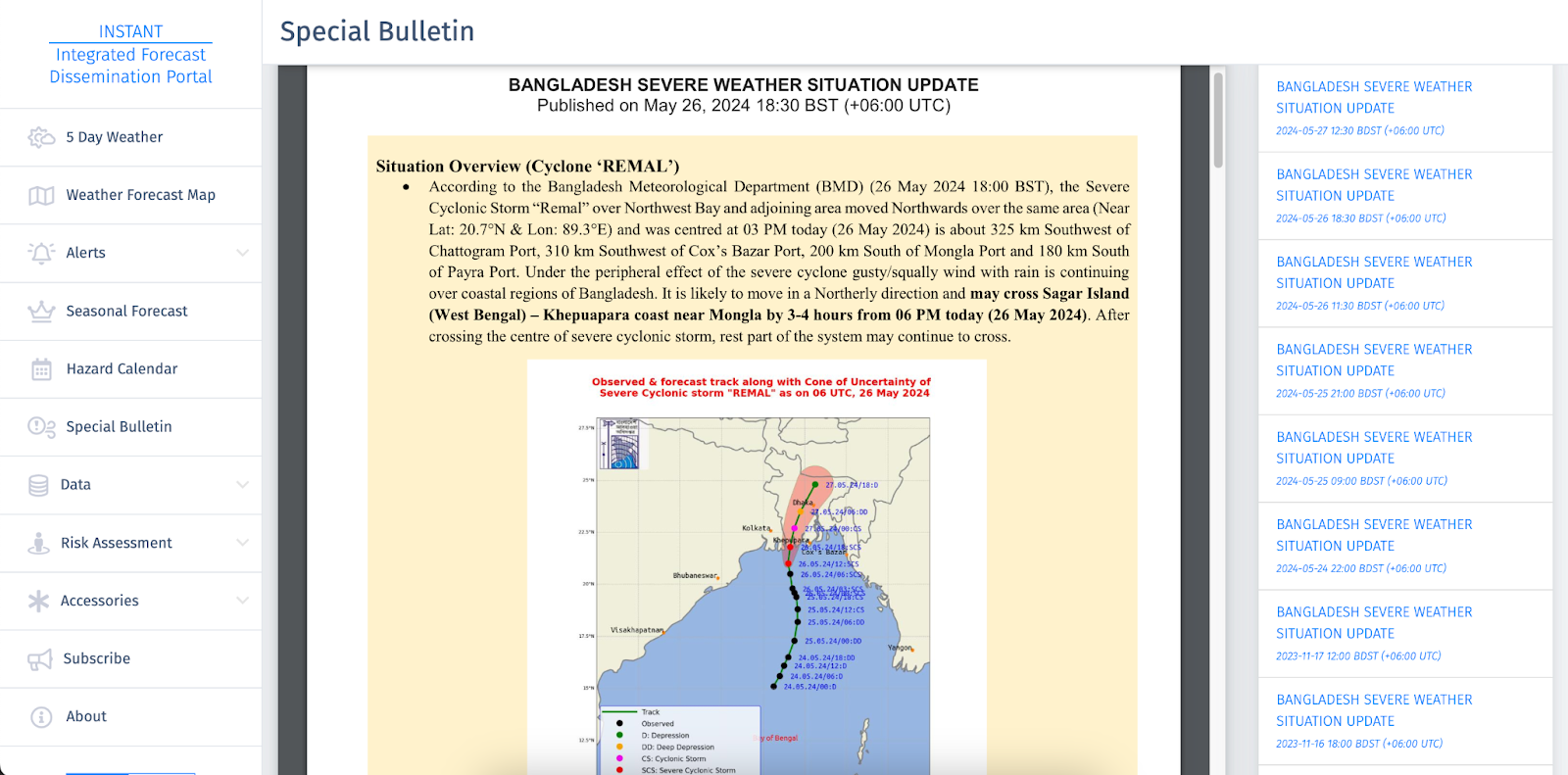
Building on the two regional workshops, participating NMHSs carried out their first heat-season IBF demonstrations from approximately March to August 2026. They tested impact-based thresholds, advisories and communication pathways for heat-related risks, strengthened engagement with health, agriculture and livestock sectors, and began using the INSTANT South Asia forecasting portal to access and visualize temperature guidance.
The third regional workshop brought countries together to review this experience, assess progress since 2025 and identify successful approaches, remaining gaps and priorities for further improvement.
Countries share progress and lessons from the heat season

A “Then and Now” review enable countries to reflect on change in their IBF capabilities and approaches between 2025 and 2026. Country representatives shared achievements, challenges and lessons from their national demonstrations.
Discussions focused on four areas: thresholds, data, impact analysis and locally relevant products; user engagement and demand-driven services; inclusive and last-mile communication for early action; and institutional arrangement for sustaining IBF services.
Country experiences highlighted the importance of connecting forecasting improvements with user needs and preparedness actions. Pakistan reported progress in localizing impact-based information for vulnerable mountain communities. Myanmar highlighted stronger collaboration with user sectors and links between heat guidance and preparedness actions in health and education. Bhutan shared advances in systematic heat monitoring, revised thresholds, and improved temperature information for users.
Maldives advancing reported progress in apparent temperature-based heat information and stronger coordination with health and disaster-management agencies. Sri Lanka highlighted multi-sector collaboration to understand and address heat risks affecting livestock and labour.
These exchanges helped RIMES and participating countries to identify remaining gaps across the IBF value chain and priority for sustaining and scaling up national demonstrations.
From heat-season lessons to next-season planning
RIMES and participating countries used lessons from the first heat-season demonstrations to plan for the next season. Countries where cold-related hazards are significant examined risks from cold waves, frost, dense fog, wind chill and snow, including cold combined with wet or windy conditions. They reviewed existing monitoring forecasts and threshold, existing thresholds, identified populations and sectors at risk, and assessed gaps between available information and user needs.
Through dedicated planning tracks, countries developed drafted plans for cold-season demonstrations or El Niño preparedness and the next heat-season, as applicable. Peer countries and technical experts provided feedback to help refine these plan.
RIMES presented updated on the INSTANT South Asia forecasting portal, including the planned cold-season module, and gather country feedback to guide further development. A practical session with the Bangladesh Department of Livestock Services also the National Livestock Advisory System to illustrate how a sector-specific decision-support tool can be co-produced with users and developed toward operational use.

Building the foundation for sustainable IBF in South Asia
Impact-based forecasting must continue to evolve as countries gain experience, user needs change, and new evidence becomes available. The workshop identified priorities for strengthening national demonstrations and developing them into sustained services.
Further progress will require stronger impact and vulnerability data, validated and locally relevant thresholds, sustained partnerships between NMHSs and user sectors, inclusive last-mile communication and clear SOPs and institutional arrangements. Continued investment in technical and operational capacity will also be essential.
RIMES Director General, Mr. A.R. Subbiah reaffirmed the organization’s commitment to supporting countries: “The South Asia Hydromet Forum is fundamentally country-driven, demand-driven and needs-based. RIMES and the UK Met Office will work to ensure that support responds to the needs, gaps and capacity requirements articulated by countries.”
Continued regional exchange, peer learning, and country-led implementation through SAHF will support the transition from pilots to sustained national services that connect forecasts with impacts, decisions and early action for communities across South Asia.
————————————
About the SAHF IBF Project: Supported by the UK government’s Foreign, Commonwealth & Development Office (FCDO) through the Weather and Climate Information Services (WISER) Asia-Pacific Programme, a part of the Climate Action for a Resilient Asia (CARA) initiative, the SAHF IBF Project aims to drive transformational change in South Asia’s capacity to deliver anticipatory, impact-based forecasting. By strengthening institutional systems and methodologies, the project helps translate weather information into actionable insights that build true climate resilience.
For more information, visit: https://www.sahf.info/